
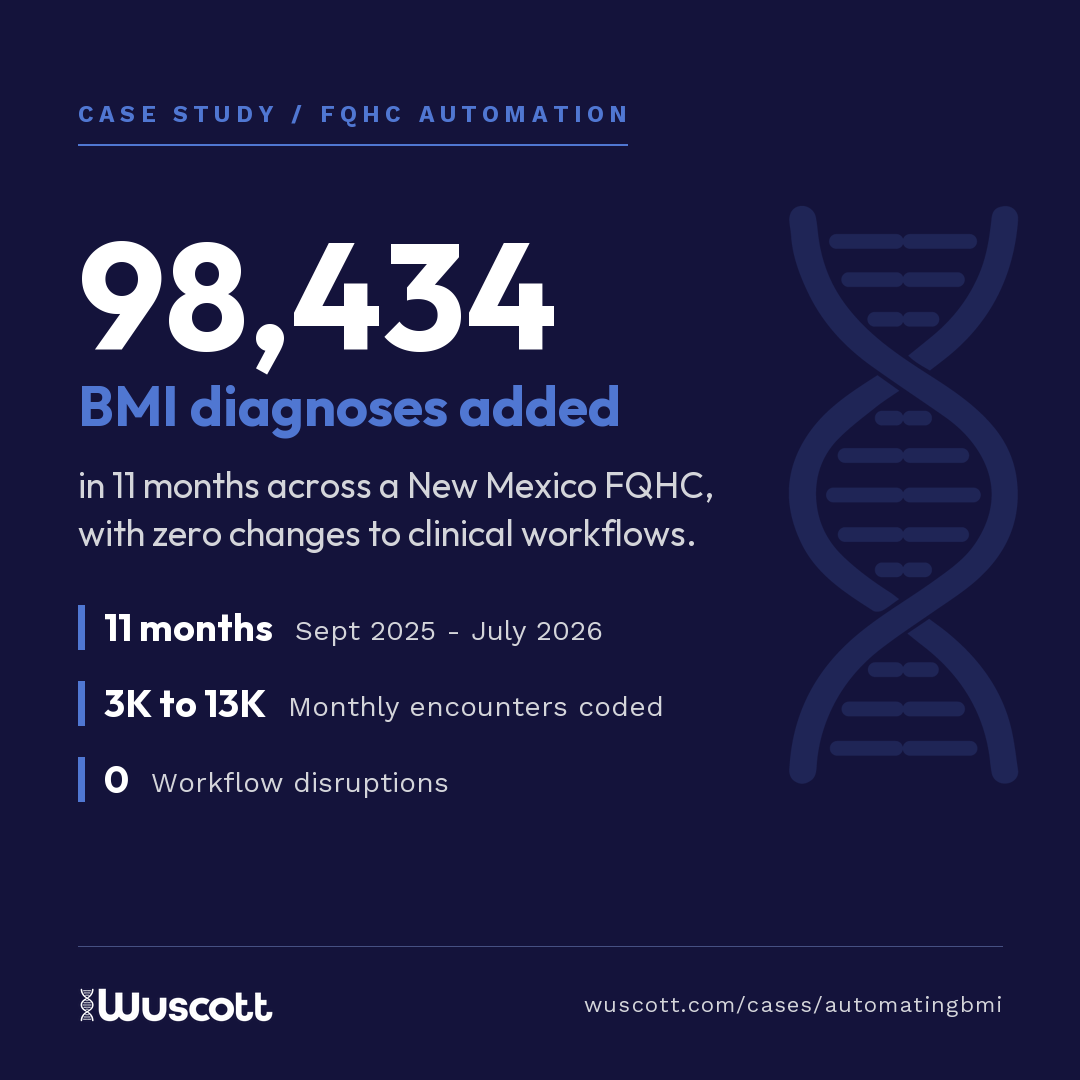
We added 98,434 BMI diagnoses to a client's claims in 11 months. Not one was typed by a person. NextGen captures height and weight at every visit. It does not turn them into a BMI code on the claim. Someone has to do that by hand, and at scale it never happens consistently. That is a system gap, not a staff problem. So we built a bot that runs inside their existing NextGen environment, finds encounters with vitals but no BMI code, and adds the right Z68 code before the claim goes out. Sept 2025 to July 2026: - 98,434 diagnoses added - ~3,000 to nearly 13,000 encounters a month - Full payer mix - Zero new clicks for providers If you run NextGen at scale, do you know whether this gap is open at your organization? Most CFOs I ask have never checked. wuscott.com/cases/automatingbmi #FQHC #HealthcareAutomation #RevenueCycle
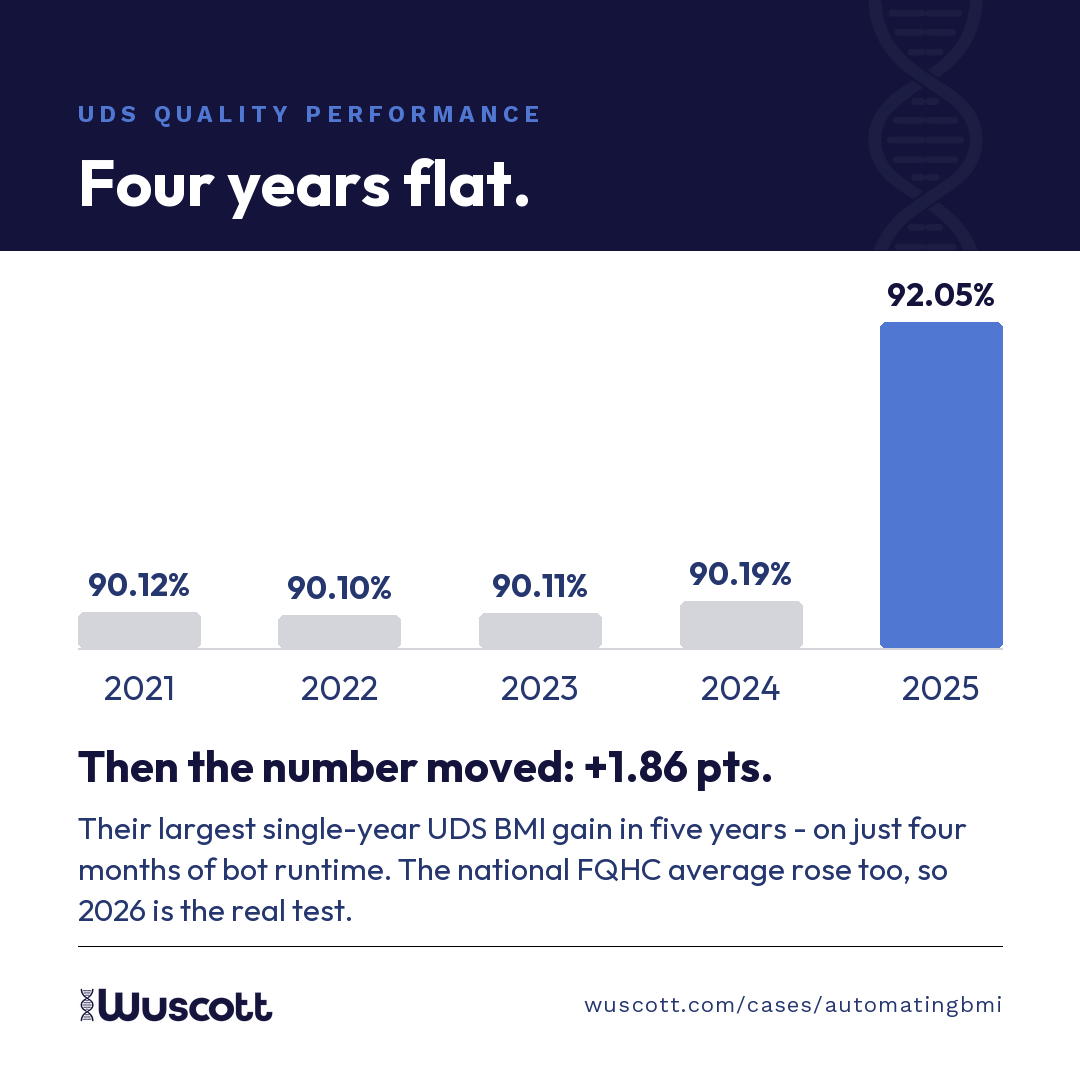
Four flat years of a UDS score. Then it moved 1.86 points. Caveats first, because that is how this should be done. Our client's HRSA UDS BMI screening rate sat between 90.10% and 90.19% from 2021 through 2024. In 2025 it hit 92.05%, their biggest jump in five years. But the national FQHC average also rose that year, 67.63% to 69.99%. And our automation only ran four of the twelve reporting months. So I will not claim one bot did all of it. What is defensible: 1st quartile ranking, 22+ points above the national average, and 2026 as the first full year of coverage. That is the year that proves it. The lesson: a quality score that will not move is usually a documentation problem, not a care problem. Has anyone here moved a UDS measure and been able to prove what caused it? wuscott.com/cases/automatingbmi #FQHC #UDS #HRSA
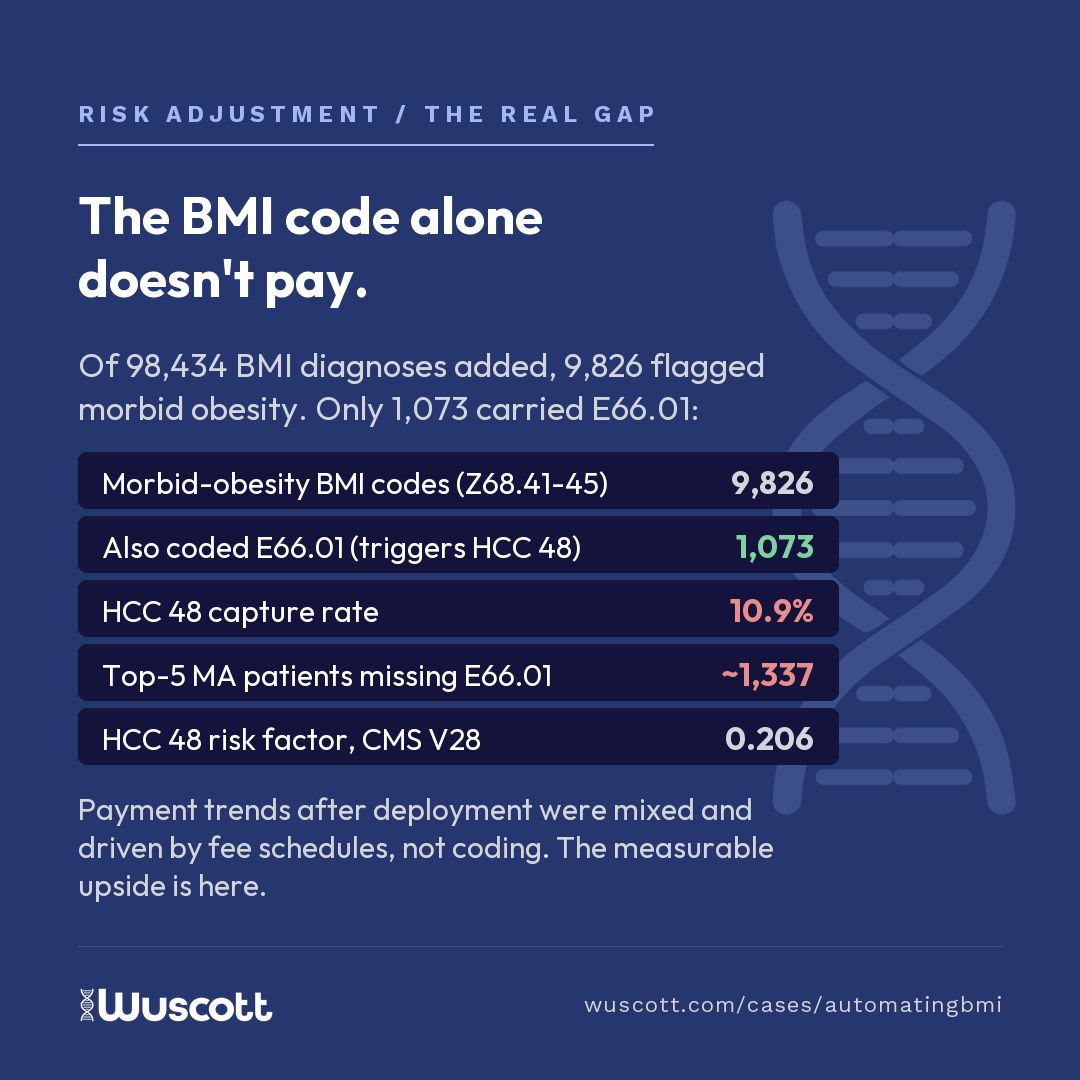
We added 98,434 BMI codes for a client. By themselves, they do not pay. 9,826 of those encounters showed morbid obesity. Only 1,073, or 10.9%, also carried E66.01, the code that maps to HCC 48 under CMS V28. Without it, the risk adjustment never happens. Across the five largest MA payers, roughly 1,337 morbidly obese patients are missing E66.01 today. HCC 48 carries a factor of about 0.206, and 2026 is the first year V28 runs at full weight. On the money: we compared payments before and after deployment and the overall effect was negligible. The real upside is still sitting in that gap. And a bot cannot close it. It can see a BMI of 41. It cannot make the clinical call. That is the provider, every time. So where does this land for you: a documentation problem, or a clinical judgment problem? wuscott.com/cases/automatingbmi #RiskAdjustment #HCC #FQHC